
15 October 2014
Whitechapel Gallery Art Icon Award

NAN GOLDIN filmed for Tate

TateShots writes: "In this TateShots interview, Goldin introduces her latest book, Eden and After; a collection of portraits she has taken of children - one of the artist's ongoing photographic subjects. The book includes portraits of Goldin's close friends' children, with moments captured from pregnancy through to teenage years of life, and provides an intimate investigation into the narrative of childhood."
2015 at the Royal Academy
I recently completed a short piece for the Royal Academy of Arts, a preview to their 2015 programme. It was produced by Cara at Squint Opera. Watch it HERE

7 September 2012
SPAZIO DI LUCE: A film for the Whitechapel Gallery

27 October 2011
GERHARD RICHTER: PANORAMA - A NEW FILM FOR TATE MODERN
Tate Modern are showing my latest film about the painter Gerhard Richter to accompany their new show Panorama. Watch it HERE.

5 July 2011
TRAUM in the Floating Cinema
My film Traum made with Isambard Khroustaliov, will be shown on Thursday 7th July 2011 on the wonderful Floating Cinema, as part of their program The Artist's Eye
17 April 2011
Joan Miró Film for Tate Modern
My latest film is playing on Level 4 at Tate Modern and on their site here.

The film explores Joan Miró's life and working practice, beginning at his first studio at his family's farm in Montroig. Guided by Miró's grandson and the curators from Tate Modern, the film visits his complex of studios and workshops near Palma, Mallorca, where he moved after the Second World War and then worked prolifically until his death at the age of 93. It includes rare material from films by Pere Portabella and Català Roca of Miró at work, and testimonials from friends who remember him as a remarkably generous and humble man.
The film was made to accompany the exhibition 'Joan Miró, The Ladder of Escape' at Tate Modern. 14 April - 11 September. Directed, filmed and edited by MPH.

The film was made to accompany the exhibition 'Joan Miró, The Ladder of Escape' at Tate Modern. 14 April - 11 September. Directed, filmed and edited by MPH.
5 December 2010
FLAT HOME
I've just posted a new film I made for the Not Applicable Festival of Experimental Music and Film this autumn in Berlin here.

Different groups of musicians including the main N/A gang and special guests, improvised to the film on two different nights, and Isambard Khroustaliov (Sam Britton) mixed the recordings to create the sound track. The idea was that the film should work as a score, so the shots are long enough for those playing to find the right feeling. I used some of the material shot for the Gauguin film. I think I prefer it without my voice/his words...

Different groups of musicians including the main N/A gang and special guests, improvised to the film on two different nights, and Isambard Khroustaliov (Sam Britton) mixed the recordings to create the sound track. The idea was that the film should work as a score, so the shots are long enough for those playing to find the right feeling. I used some of the material shot for the Gauguin film. I think I prefer it without my voice/his words...
22 November 2010
DP on The Silver Goat
I just shot a feature film, The Silver Goat, directed by Aaron Brookner. It's the first time I've worked as a DP on a full scale feature film. For someone used to doing most things alone the experience of being part of a crew was fantastic . I shot the whole thing handheld on my 5D Mark II in black and white using its ability to work in low light where possible, aiming for a strange hyper-natural noire style. This seemed to fit the bleakness of the script; a dark psychological drama. Watch the trailer here.
 We shot the entire feature in 10 intense shooting days which is pretty unheard of, all in locations around London. I had access to some great lights thanks to Ben Liddell. Thanks also to Anne Haaning who stepped in to shoot some of the steadycam scenes and pull focus. Katy Zwetsloot-Hyatt kept things sane as cheerful camera assistant.


The film is being edited in Buenos Aires and will be ready for festival release some time in spring if all goes well.

19 October 2010
A film about Ai Weiwei's Sunflower Seeds

5 October 2010
GAUGUIN IN HIS WORDS @ TATE MODERN
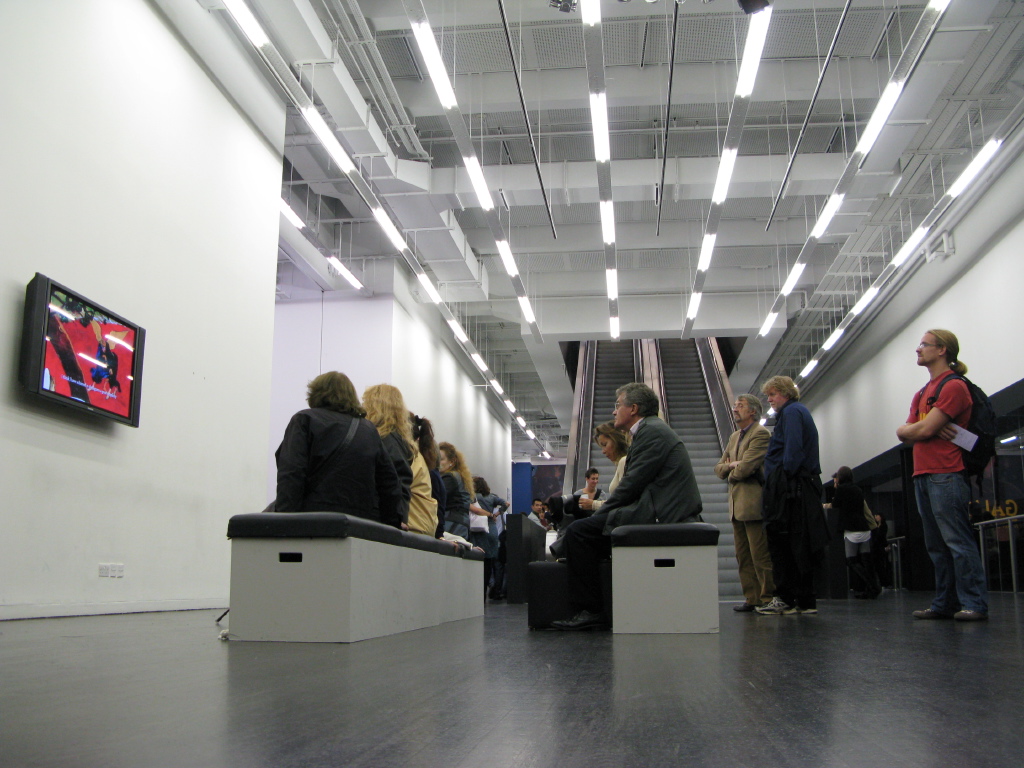
My latest project, ‘GAUGUIN IN HIS WORDS’, based on the letters of Gauguin to his friends and family, is currently playing on the 4th floor of the Tate Modern. I filmed it with my new 5D Mark II which has opened up a lot of cinematic possibilities for me.
Having read so many of his letters I can't say that I like the man, but you have to appreciate his self-belief and intense focus which he sustained throughout his many travels. I chose to avoid his moaning letters to his friends and estranged wife, and tried to concentrate instead on the moments when he talks directly about his art.
It was commissioned by Kate Vogel who used to run Channel 4's 3 Minute Wonders and now runs Tate Media. It was made to accompany the Gauguin exhibition which runs till late 2010.
The short film, based entirely on Gauguin's letters from the late 1900s, explores the artist's transition from conventional family man to avant-garde pioneer and maverick leader of the post-impressionist movement.
“Be an Impressionist to the bitter end and be afraid of nothing!”
(To Emile Bernard, 1889)
23 March 2010
Installation up and running

I haven't posted for several weeks as I've been very busy shooting and editing in preparation for the Northern Lights festival which opening this Sunday in Newcastle.
I am finally showing three films: The first, called provisionally Gentle Oblivion, which is projected large on the wall, describes my half sister's life in France, how well she is coping and enjoying life despite her lack of memory.
Then two other short films are shown on Plasma screens with sound from headphones. Dementia in the Family describes Doug's family's heroic efforts to care for him and his dementia at home. (See previous post An Adaptive Family)

The Science of Dementia is a 20 minute piece in which a group of leading researchers attempt to explain what causes dementia and Alzheimer's Disease, but ultimately admit they are still somewhat in the dark.

I hope that the three films will together begin a dialogue about what it means to be diagnosed with Alzheimer's Disease, how we need to rethink our attitudes to memory loss given how likely we are to experience it directly or indirectly through family and friends.
The films are on show at the Great North Museum in Newcastle. Information about the installation can be found here:
I hope to post all 3 films next week on vimeo and they will be viewable on this blog.
27 January 2010
An Adaptive Family
On Sunday I spent the day filming with an amazing family which has unquestioningly taken on the task of coping with old age and dementia at home. Ever since Doug (my friend Adem's 91 year old Grandfather) was discharged from hospital after a long stay with for a broken pelvis, he has been living in a bed in the front room of Adem's mother and step father's terrace house.

Sunday Lunch:

Doug before going to hospital:
He went into hospital physically well but was showing signs of relatively mild dementia. During his 3 months stay, he became and has remained completely confused, and is now unable to hold a conversation, although he talks a lot and can more or less express his needs. He is incontinent and needs to be changed regularly.
I wanted to film the family in action because I was so impressed by how they were coping with such an unusual set up in their living room. Adem's step Father Rick no longer works, and has become the full time carer. Adem's mother Carol gets back from work and immediately helps out. They are often kept awake right through the night. The rest of the family helps whenever they can to give them breaks because Doug can't be left alone in the house.
Although a care team will come three times a day to wash and change Doug's pads and dressings, the family will change him at least another six times in between these visits. It requires some serious nursing skill and is not for the squeamish. ALthough no one gave them any formal training before Doug's discharge they do it all with great humour and look after him with incredible patience. They are reconciled to it being their role, Doug having looked after everyone when they were young. I wonder how many other families around the country are doing the same thing with the same stoicism.
An edit of the material shot with Doug will form part of the triptic of films in Newcastle if things go as planned.
20 January 2010
Keeper
I recently finished reading Keeper, Andrea Gillies's prize winning account of a year and a half spent caring for her Alzheimer's suffering mother-in law Nancy, and depressed and ageing father-in law, who had moved in with her and her young family in a big house in the middle of nowhere somewhere in the north of Scotland.
Its an utterly unromantic memoire of a ferociously difficult period of her life. Whereas in John Baily's books about caring for his wife, the writer Iris Murdoch, his profound love for her after a life shared together justified the sacrifices her Alzheimer's forced him to make, it was much harder for Gillies to set her life aside as she'd hardly known her mother-in-law even when she was in good health.
The book alternates between descriptions of her struggles to care for Mother and Father while trying to maintain her own self respect by working as a writer, and clearly written summaries of her research into the science behind dementia gleaned from all the books and blogs she could find on the subject. She precisely documents the irrationality of the effects of disease as it works its way through various important parts of Nancy's brain. The rapid mental deterioration combined with her physical health and mobility makes her mother almost impossible to cope with and ultimately drives Gillies herself into depression and near collapse.
She also describes the problems with social and health services who are supposed to be helping; how difficult it is to understand then work with the system, the constant intrusions into the home from care staff putting family on public display and the difficulty of getting first repsite care, and eventually a full time place in an Alzheimer's equipped home.
The book reminded me how relatively well my sister currently is given the prognosis of her diagnosis, and how fortunate she is to have remained relatively stable for the past five or so years. It helped crystallise my desire to film her in her good spirits, to find ways to film the way she is still able to get intense pleasure from life despite her lack of a working memory. I have no idea what will happen in the years to come, and I hope that somehow my sister does not follow the same path as Nancy, but for now I am determined to focus on the positive.
Its an utterly unromantic memoire of a ferociously difficult period of her life. Whereas in John Baily's books about caring for his wife, the writer Iris Murdoch, his profound love for her after a life shared together justified the sacrifices her Alzheimer's forced him to make, it was much harder for Gillies to set her life aside as she'd hardly known her mother-in-law even when she was in good health.
The book alternates between descriptions of her struggles to care for Mother and Father while trying to maintain her own self respect by working as a writer, and clearly written summaries of her research into the science behind dementia gleaned from all the books and blogs she could find on the subject. She precisely documents the irrationality of the effects of disease as it works its way through various important parts of Nancy's brain. The rapid mental deterioration combined with her physical health and mobility makes her mother almost impossible to cope with and ultimately drives Gillies herself into depression and near collapse.
She also describes the problems with social and health services who are supposed to be helping; how difficult it is to understand then work with the system, the constant intrusions into the home from care staff putting family on public display and the difficulty of getting first repsite care, and eventually a full time place in an Alzheimer's equipped home.
The book reminded me how relatively well my sister currently is given the prognosis of her diagnosis, and how fortunate she is to have remained relatively stable for the past five or so years. It helped crystallise my desire to film her in her good spirits, to find ways to film the way she is still able to get intense pleasure from life despite her lack of a working memory. I have no idea what will happen in the years to come, and I hope that somehow my sister does not follow the same path as Nancy, but for now I am determined to focus on the positive.
12 January 2010
Presenting research: Installation plans for NLFF
It looks like I will be presenting my work at the Great North Museum in Newcastle during the week of the Northern Lights Festival, 20th - 27th March 2010. I plan to create an installation that will take up the end section of a huge new space. This space will be divided by a partition and I will take the end section by the window, which can be blocked off.

This is a sketch showing an impression of what I am hoping might be possible for the installation. Budgets haven't been fixed, and much depends on what I am able to produce in the coming 3 months, so this is still up for discussion.

I would like the room to be fairly dark, with the biggish screen (3 or 4m wide) in the middle being ideally projected on from the back.
The film on loop on this central screen would be a meditative piece, about 10 minutes long designed to work as a loop so it doesnt matter too much at which point you walk in. It would be structured as a series of short 'questions', drawn from my initial proposal which remains for me a good starting point. These questions will be explored and expanded upon through the footage shot during the project, with my sister in France, at the Institute of Ageing Brain Bank, and with elements of other pieces of research. It will contain my own narration where necessary to get the question across.
Then around the room, possibly against the walls, but ideally pointed away from the screen, are 3 or 4 TV like monitors playing different short 'documentaries' on each. These films will be self-contained succinct films about some of the most interesting things and places I have been exploring.
1: How medical researchers understand Dementia. (mainly drawn from time at the IAH in Newcastle
2: Ward 23 - The difficulty of caring humanely for those with dementia.
3: SPECAL - The theory and practice of this new approach as explained by Penny and her team.
4: Adems Grandpa - A weekend at the home of my friend Adem's parents, who are caring for their 90 year old grand father. He has been moved into their front room for the past few months where he is pretty much confined to bed, and suffers from advanced dementia. The film will explore how the family is coping with this period of change.
I imagine each table would have a book and pens with an open invitation to write comments in response to the films.
I also hope to have a computer set up in the space, connected to this blog, which people would be able to read and add to.
I plan to be in the room all week with a small editing suite, making changes to the films, talking to people, and explaining it all, so that it remains a work in progress, and doesn't get too fixed at this stage.
It would require:
1 x Good video projector
1x amp and speakers
1 x rear projection screen and stand
4 x TV/ Monitor
4 x DVD player / computer with DVD playing capabilities
8 x headphones (2 on each table) -these can be very cheap these days
4x tables and chairs
1 x computer with monitor - online
1 x table and chair
Seeking donations/loans/suggestions! Please contact me with ideas!
martin at martinhampton.com
11 January 2010
The Alzheimer's Choir
The Alzheimer's Choir, a beautifully made documentary, screened on BBC2 at the end of last year, starts at a meeting of "Singing for the Brain", a group of singers in Bristol made up of Alzheimer's sufferers and their spouses.
The blurb for the program explains, "As the group bursts into song, an extraordinary thing happens. People who may not even recognise their own partner find the words of a song learnt half a century earlier, and suddenly - just for length of time it takes to sing a few verses - it is impossible to tell who is the Alzheimer's patient and who is the carer."
The phenomenon of music opening the memories of Alzheimer's patients is fascinating and much discussed elsewhere, but the film doesn't really concentrate much on this. It's more about individuals' experiences of Alzheimer's, either the sufferer's or the carer-partner's. These moving accounts are told direct to the camera in a series of set-piece interviews in the homes of some of the people gleaned from the Alzheimer's choir. Its a gentle film. We don't see directly the dark face of the disease but you get a sense of its vicious cruelty lingering in its aftermath.
Watch it here if you can on the iPlayer before it is removed on 21 January 2010
The blurb for the program explains, "As the group bursts into song, an extraordinary thing happens. People who may not even recognise their own partner find the words of a song learnt half a century earlier, and suddenly - just for length of time it takes to sing a few verses - it is impossible to tell who is the Alzheimer's patient and who is the carer."
The phenomenon of music opening the memories of Alzheimer's patients is fascinating and much discussed elsewhere, but the film doesn't really concentrate much on this. It's more about individuals' experiences of Alzheimer's, either the sufferer's or the carer-partner's. These moving accounts are told direct to the camera in a series of set-piece interviews in the homes of some of the people gleaned from the Alzheimer's choir. Its a gentle film. We don't see directly the dark face of the disease but you get a sense of its vicious cruelty lingering in its aftermath.
Watch it here if you can on the iPlayer before it is removed on 21 January 2010
14 December 2009
Dementia Poetry
I was recently introduced to the work of John Killick by David Lale, a filmmaker also interested in the subject of dementia.
Killick is a writer who has published two books by of poems by people with dementia. The poems are fashioned out of the speech of individuals with the condition. He explains,
"I write down or tape-record, and then transcribe, the words of a person. The resulting poem involves selection, but I never add a word. I share the poem back with the person and seek their permission to show to others, and in some cases to publish. "
He gives these poems a title and form on the page. They are beautiful and poignant. Some read like a monologue from a play by Samuel Beckett; the sentences struggle to work, nothing is certain and all linguistic rules seem provisional. But even the most confused collection of words offer more than mere clues, they speak for a person living in a world of feeling, a human being with worries and desires who should be listened to carefully. Killick believes that to approach these texts as poetry helps one to bypass the often unhelpful habits of rational thought. I would agree that to tune into, and give attention to the seemingly bizarre metaphores and images created by someone with dementia, a carer can gain important insights, which can be used by a Specal-like care approach to make the sufferer's life much less frightening.
ON THE OTHER SIDE
Killick is a writer who has published two books by of poems by people with dementia. The poems are fashioned out of the speech of individuals with the condition. He explains,
"I write down or tape-record, and then transcribe, the words of a person. The resulting poem involves selection, but I never add a word. I share the poem back with the person and seek their permission to show to others, and in some cases to publish. "
He gives these poems a title and form on the page. They are beautiful and poignant. Some read like a monologue from a play by Samuel Beckett; the sentences struggle to work, nothing is certain and all linguistic rules seem provisional. But even the most confused collection of words offer more than mere clues, they speak for a person living in a world of feeling, a human being with worries and desires who should be listened to carefully. Killick believes that to approach these texts as poetry helps one to bypass the often unhelpful habits of rational thought. I would agree that to tune into, and give attention to the seemingly bizarre metaphores and images created by someone with dementia, a carer can gain important insights, which can be used by a Specal-like care approach to make the sufferer's life much less frightening.
ON THE OTHER SIDE
I'm just going round to see what's round the corner...
I've lived here twenty-five weeks in the city,
up and down the language, twice up and down...
I'd better just have another look...
I'll tell you if you can understand the language.
And I'm talking, talking all the time...
I'm just off to see if it's changed at all...
I didn't know if you would understand,
with you living on the other side...
I'll just see if it's all right over there...
Young girls wearing white on the other side
of their dress getting married...
I'll just see if I can get far enough along...
©John Killick
Other poems are full of memories, this by Ian McQueen, "a younger man with dementia from the west of Scotland",
DEFENCE
Bobby was bigger than me.
And when I got it, I got
a right good thwack from this bloke.
He just ladled into me,
and I couldn’t stotter, I was
lying in the playground. Biff. Out.
Bobby was going to get a doing.
And I administered it.
If you steam into me: Stars.
I cloaked myself in my self
and that was good for me.
I got that from him too.
I had my dose
and Bobby had his dose.
Big Al’s bigger than me too,
but I’m not going
to lie down under his blows.
He’s in there. I can still
cloak myself in my self.
2 December 2009
Institute of Ageing: A tour
While in Newcastle last week I revisited the Institute of Ageing run by Professor Kirkwood. I was shown around their suite of new buildings mostly paid for by the Wellcome Trust, full of sparkling new laboratories and rooms for examining volunteers for the multitude of clinical trials that are running at any one time.

In order to understand the effects of ageing on the brain, much of the important research depends on studying volunteers in the later stages of life right through to death, when their donated brains are carefully removed for detailed analysis and storage. They are kept in the Brain Tissue Resource, or brain bank, where over a thousand of these donated brains are kept either in specially cold freezers or preserved in tubs. For inspection, the brains are usually sliced very finely for examination under microscopes.


I was also shown the 'Gait Lab', a windowless room full of cameras, where they use Motion Capturing technology, designed for the animation film industry, but used here to examine the effects of different diseases like dementia with Lewy bodies and Parkinson's on the way people walk. Apparently it could be used as a diagnostic tool in the future, because movement is one of the first things effected by both diseases.


The institute is also home to one of the most powerful MRI scanners in the country. It is used to examine the brains of living volunteers to try to understand how exactly brains are effected by diseases like Alzheimer's, and how these changes alter the behavior of the sufferer.


My plan is to return and film interviews in and around each of these locations with a leading researcher in each field, to try to construct a comprehensible picture of the current state of research into dementia, and how it is understood.


26 November 2009
Ward 23 - dementia in hospital - reposted
November 25th. Yesterday I accompanied a clinical psychologist on a visit to Ward 23 at the Queen Elizabeth Hospital in Gateshead. Only couple of years old, it was designed specifically for older people with mental issues who have been brought to hospital with some kind of physical problem, the ward is one of only three in the country set up in this way and is a bit of an experiment. More commonly hospitals would not separate so distinctly those with and without mental conditions meaning that a whole ward could be disrupted by a few people with dementia.
Out of the 24 patients on Ward 23 most seemed to have some kind of dementia and were still just about able to walk. Several wandered up and down the corridor looking lost, others sat in a group waiting for an imaginary bus to take them home. The nurses and auxiliaries I met seemed kind and caring and were doing what they could to keep on top of things. The doctors knew each patient's case intimately and were working to get them out of hospital as quickly as possible. They objected to recent reports about over-sedation of the elderly in care, saying on their ward it was only used as an absolute last resort. However there are only ever between 4 and 8 nurses on duty at any one time, when in an ideal world you would probably want 1 on 1 care for many of the patients. One of the nurses explained how difficult it is to know what to do with the patients, "Look at them" she said, pointing to the group hanging around expectantly in the corridor. "They're all ready and waiting to leave right now. There's no way to persuade them that they're not going anyway..."
I listened to the psychologist talking to a patient who didn't have dementia but was feeling very low. She was clearly aware of the poor state of her own health and there wasn't much he could say to change her heart. I couldn't help comparing her in her entirely justifiable depression with the joking and flirtatious lady with dementia who held my hand while lining everyone up to catch the bus for the tenth time. Without wishing dementia on anyone, it does at least offer the potential blessing of sparing the elderly sufferer the awareness of their own predicament.
I hope to be able to film on Ward 23 because I think it's somewhere that graphically shows how difficult a thing dementia is to deal with, particularly on an institutional scale: It's a 'state of the art facility', the staff are good and as well trained and experienced as any you will find anywhere, but it doesn't mean they don't struggle to cope with the harsh reality of dementia.
It's going to be incredibly complicated to get the necessary consents from the patients to film there although Gateshead Health Trust does seem to be behind the project.
Out of the 24 patients on Ward 23 most seemed to have some kind of dementia and were still just about able to walk. Several wandered up and down the corridor looking lost, others sat in a group waiting for an imaginary bus to take them home. The nurses and auxiliaries I met seemed kind and caring and were doing what they could to keep on top of things. The doctors knew each patient's case intimately and were working to get them out of hospital as quickly as possible. They objected to recent reports about over-sedation of the elderly in care, saying on their ward it was only used as an absolute last resort. However there are only ever between 4 and 8 nurses on duty at any one time, when in an ideal world you would probably want 1 on 1 care for many of the patients. One of the nurses explained how difficult it is to know what to do with the patients, "Look at them" she said, pointing to the group hanging around expectantly in the corridor. "They're all ready and waiting to leave right now. There's no way to persuade them that they're not going anyway..."
I listened to the psychologist talking to a patient who didn't have dementia but was feeling very low. She was clearly aware of the poor state of her own health and there wasn't much he could say to change her heart. I couldn't help comparing her in her entirely justifiable depression with the joking and flirtatious lady with dementia who held my hand while lining everyone up to catch the bus for the tenth time. Without wishing dementia on anyone, it does at least offer the potential blessing of sparing the elderly sufferer the awareness of their own predicament.
I hope to be able to film on Ward 23 because I think it's somewhere that graphically shows how difficult a thing dementia is to deal with, particularly on an institutional scale: It's a 'state of the art facility', the staff are good and as well trained and experienced as any you will find anywhere, but it doesn't mean they don't struggle to cope with the harsh reality of dementia.
It's going to be incredibly complicated to get the necessary consents from the patients to film there although Gateshead Health Trust does seem to be behind the project.
21 November 2009
SPECAL CONVERSION
After reading and posting about SPECAL, the organisation run by Penny Garner (which proposes a radical but highly practical approach to caring for people with dementia) I contacted them and asked if I could film one of their training days. Penny herself replied and suggested I should start by participating in one of the courses. So I signed up for a one day session for professionals working in the care sector. I spent Thursday at their headquarters in an old hospital in Burford near Oxford with a group of people who had come from as far as New Zealand to learn how to apply the Specal way to their work. Making up the group were managers of nursing homes run on holistic principles, psychiatric nurses working for the NHS who objected to the over-use of medication to tranquilise patients with dementia, a journalist, a lawyer working with vulnerable elderly clients, and a behavioral therapist.
In the morning 2 female volunteers went back over the ideas in the book, clarifying what SPECAL is about, then in the afternoon Penny herself went into greater detail and discussed strategies for converting nursing homes or other institutions into SPECALed environments.
As yet I haven't seen SPECAL in action with a 'client' (as they refer to those with dementia) but from all my current understanding of it and my experiences of dementia, I think its a completely sensible and excellent idea. Penny is utterly convinced that with time its principle ideas will be adopted nationally and internationally as THE way to cope with the problem of dementia. The problem is that at the moment she is struggling to get the backing of the Alzheimer's Society which dominates the field and is actively distancing itself from SPECAL. On its website it has a statement outlining its reservations:
"SPECAL in particular supports the view that it is acceptable in many instances to lie to people with dementia and to move away from offering them an effective range of choices."
Bizarrely, immediately below their statement they have published an account by a lady called Pam for whom SPECAL worked and was the answer to everything. She writes:
"I felt I should write this article so that the many people who are living with this dreadful disease, both carers and sufferers, should feel some hope that there is a potential way of coping with the disease. I have met many people who are as devastated as we were. I believe everyone should at least have the opportunity to access SPECAL."
From everything I can understand about the situation, the problem is that large institutional bodies like the Alzheimer's Society and the NHS can't embrace SPECAL because of the way it accepts dementia for what it is, and then exploits the few benefits it has to offer. For example, the fact that someone with dementia doesn't get bored of repetition means that you can constantly return to a memory or action which makes them feel safe and in control, as opposed to being lost and confused. The central goal of SPECAL is to create and sustain permanently the 4 states of emotional wellbeing:
Personal Worth Agency Social Ease Trust
Yes, this does involve a degree of deception but it must be done out of love and in good faith in order to avoid the far more cruel alternative; that being to rub the sufferer's nose in the truth of their dire prognosis. Of course people with dementia should be given the chance to exercise choice for as long as possible but there comes a time when such politically correct considerations become meaningless. This is a matter for the judgement of the individual's carers, one of many difficult decisions that have to be made as someone becomes progressively more dependent. Perhaps SPECAL should produce something like a Organ Donor card which says "If I ever get dementia I hearby give my consent to be guided into SPECAL LAND by those who know me best:________"
A woman on the course had the theory that in order for the Alzheimer's Society to get its funding it needs to sustain the narrative that dementia is a hopeless, horrible, disease for which a cure must be found by people spending loads of money on medical research. The fact that SPECAL's book is called 'Contented Dementia' is too much for them to handle...
Penny is convinced that that the field of dementia care is nearing a tipping point and as a separate documentary project I think it could be interesting to follow the story of her attempts to bring about this transformation. Either way next week I am going back to film their weekly Friday session where clients and their careers spend the day at the centre. I am also going to try to film at the Beth Ezra nursing home whose staff have done the same course and are apparently experiencing good results.
Subscribe to:
Posts (Atom)


 Posts
Posts

